A very HABITABLE planet circling sun discovered by scientists in huge breakthrough

A very HABITABLE planet circling sun discovered by scientists in huge breakthrough
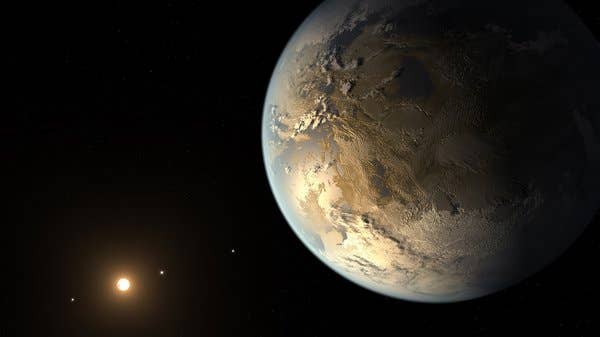
In a monumental leap for astronomy, scientists have unveiled the existence of a potentially habitable exoplanet, HD 20794 d, orbiting a star strikingly similar to our Sun. This discovery, situated a mere 20 light-years away in the constellation Eridanus, not only brings us closer to answering the age-old question of extraterrestrial life but also offers an unprecedented opportunity to study a planet that could harbor conditions suitable for life as we know it.

HD 20794 d is classified as a "super-Earth" due to its mass being approximately six times that of our planet. Its host star, HD 20794 (also known as 82 Eridani), is a G-type star akin to the Sun, making this planetary system an intriguing subject for comparative studies. The planet's orbit places it within the star's habitable zone—the region where conditions might be just right to allow the presence of liquid water, a crucial ingredient for life.
The journey to this groundbreaking discovery began in 2022 when Dr. Michael Cretignier, a postdoctoral researcher at the University of Oxford, detected a subtle, periodic signal while analyzing archived data from the High Accuracy Radial Velocity Planet Searcher (HARPS) spectrograph at Chile's La Silla Observatory. This signal suggested the gravitational influence of an orbiting planet. However, due to its faintness, there was uncertainty about whether the signal was genuine or merely an artifact of stellar activity or instrumental noise.

To confirm the planet's existence, an international team of researchers meticulously analyzed over two decades of high-precision measurements from both HARPS and its successor, ESPRESSO. These instruments are among the most advanced tools available for detecting minute variations in starlight caused by orbiting planets. The team's rigorous analysis, which involved eliminating all possible sources of contamination, ultimately verified the presence of HD 20794 d.
One of the most intriguing aspects of HD 20794 d is its highly elliptical orbit. Unlike Earth's nearly circular path around the Sun, HD 20794 d's orbit causes it to swing between the inner and outer edges of the habitable zone. This means that any water present on the planet could cyclically freeze and thaw as it moves closer to or farther from its star. Such dynamic environmental conditions could have profound implications for the planet's climate and potential habitability.

The proximity of HD 20794 d to Earth makes it an ideal candidate for future observational studies. Its relative closeness ensures that its light signals are more accessible and robust, facilitating detailed examination. Upcoming telescopes, such as the European Southern Observatory's Extremely Large Telescope, are expected to play a pivotal role in directly imaging the planet and analyzing its atmosphere for biosignatures—chemical indicators that could suggest the presence of life.
Despite the excitement surrounding this discovery, scientists caution that being in the habitable zone does not guarantee that HD 20794 d is habitable. Key factors such as the planet's atmospheric composition, surface conditions, and potential geological activity remain unknown. Further research is essential to determine whether this super-Earth possesses the necessary conditions to support life.
The confirmation of HD 20794 d's existence marks a significant milestone in the search for Earth-like exoplanets. It underscores the importance of long-term data collection and the development of sophisticated analytical techniques in detecting and studying distant worlds. As Dr. Cretignier aptly put it, "While my job mainly consists of finding these unknown worlds, I'm now very enthusiastic to hear what other scientists can tell us about this newly discovered planet, particularly since it is among the closest Earth analogues we know about and given its peculiar orbit."
In conclusion, the discovery of HD 20794 d opens a new chapter in exoplanet research. Its unique characteristics and favorable location provide a valuable opportunity to deepen our understanding of planetary systems and the potential for life beyond our solar system. As technology advances and new observational platforms come online, HD 20794 d will undoubtedly be a focal point in the ongoing quest to explore the cosmos and uncover the mysteries of the universe.


Comments
Post a Comment