5,000-Year-Old Egyptian Map Depicts America—Could This Discovery Rewrite History?

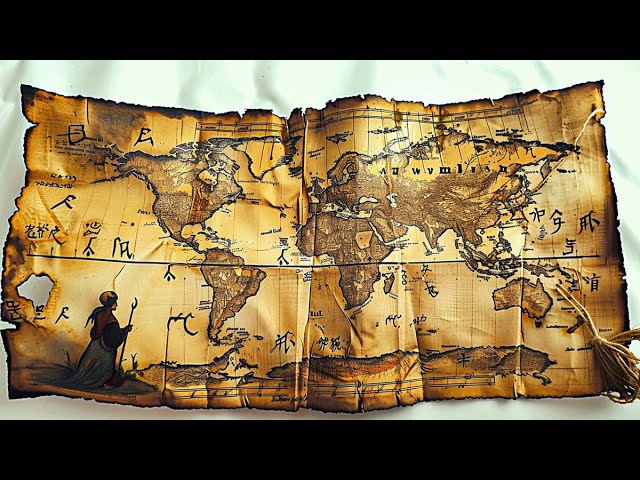
A shocking new discovery has surfaced from ancient Egypt, challenging everything we thought we knew about global exploration. A 5,000-year-old map, found within an Egyptian tomb, appears to depict the Americas with astonishing accuracy. This finding raises serious questions about the long-held belief that Christopher Columbus was the first non-native to reach American shores. Could ancient Egyptians—or another civilization—have made contact with the Americas thousands of years before Columbus?
.png)
Adding to the intrigue, another artifact, the Nubia Egg, has been discovered—a 7,000-year-old ostrich eggshell intricately carved with symbols that eerily resemble the pyramids of Giza. These two discoveries have sent shockwaves through the historical community, forcing scholars to reconsider the connections between ancient civilizations across continents.

An Egyptian Map That Shouldn’t Exist.
The ancient Egyptian map, estimated to be 5,000 years old, is unlike anything seen before. It features geographical outlines that closely resemble North and South America, drawn with surprising precision. Until now, historians have believed that the first recorded transatlantic voyage occurred in 1492, when Columbus set sail from Spain. However, this map suggests that the ancient Egyptians or an unknown civilization had knowledge of the Western Hemisphere millennia earlier.

Skeptics argue that the map could simply be an artistic interpretation of unknown lands, but the accuracy of its depiction, especially of coastlines and recognizable landmasses, suggests otherwise. If this map is indeed a representation of America, it would force historians to rethink the timeline of transoceanic exploration and the possibility of ancient contact between civilizations separated by vast oceans.

The Mysterious Nubia Egg and Its Hidden Meaning.
The discovery of the Nubia Egg, an intricately designed 7,000-year-old ostrich eggshell, has added even more mystery to the debate. Found in Lower Egypt, this ancient artifact features carvings of three triangular structures that closely resemble the pyramids of Giza. But there’s a major problem—mainstream historians date the construction of the Giza pyramids to around 4,500 years ago. So how could a 7,000-year-old artifact accurately depict them?
The egg also features a serpent-like design, which many believe symbolizes the Nile River. But the real debate centers on the three triangular shapes. Are they truly representations of the pyramids, built thousands of years before their accepted dates? Or are they simply mountains, as some scholars argue? The precision of the carvings and the symbolic alignment with later Egyptian monuments suggest that our understanding of Egyptian history might be deeply flawed.
If the pyramids were built much earlier than currently believed, it would rewrite the entire timeline of ancient Egyptian civilization. It would also raise questions about who built them and whether ancient Egyptians possessed knowledge passed down from an even earlier, possibly lost civilization.
Were Ancient Civilizations More Advanced Than We Thought?
Both the 5,000-year-old map and the Nubia Egg hint at something even more profound: the possibility that ancient civilizations had far greater knowledge of geography, engineering, and global connections than previously assumed.
For decades, researchers have speculated about pre-Columbian transoceanic contact, with theories ranging from Viking explorations to Phoenician seafarers reaching the Americas long before Columbus. However, these new discoveries from Egypt suggest a much older connection—one that predates all known theories.
Some researchers speculate that ancient Egyptians, or a civilization that influenced them, may have had the capability to sail across the Atlantic. Others suggest that lost records or forgotten maps may have preserved knowledge of lands far beyond the Nile.
Adding to the mystery, there have been strange findings in the Americas that some believe point to ancient Egyptian influence. Egyptian-style artifacts, symbols, and even linguistic similarities have been noted by researchers exploring ancient ruins in the Americas. While mainstream historians remain skeptical, these latest discoveries could provide compelling new evidence to support the idea that the ancient world was far more connected than we ever imagined.

Could These Discoveries Rewrite History?
As scholars and archaeologists continue to study these incredible artifacts, one thing is clear: history may not be as simple as we once believed. The 5,000-year-old Egyptian map and the 7,000-year-old Nubia Egg suggest that civilizations from the distant past had access to knowledge and connections that defy modern expectations.
Are these findings proof of an ancient global civilization with knowledge of the Americas? Could the true history of human exploration and discovery be far older than we realize? While many questions remain unanswered, one thing is certain—these discoveries demand a reexamination of history, pushing us to explore the mysteries of the past with an open mind.


Comments
Post a Comment